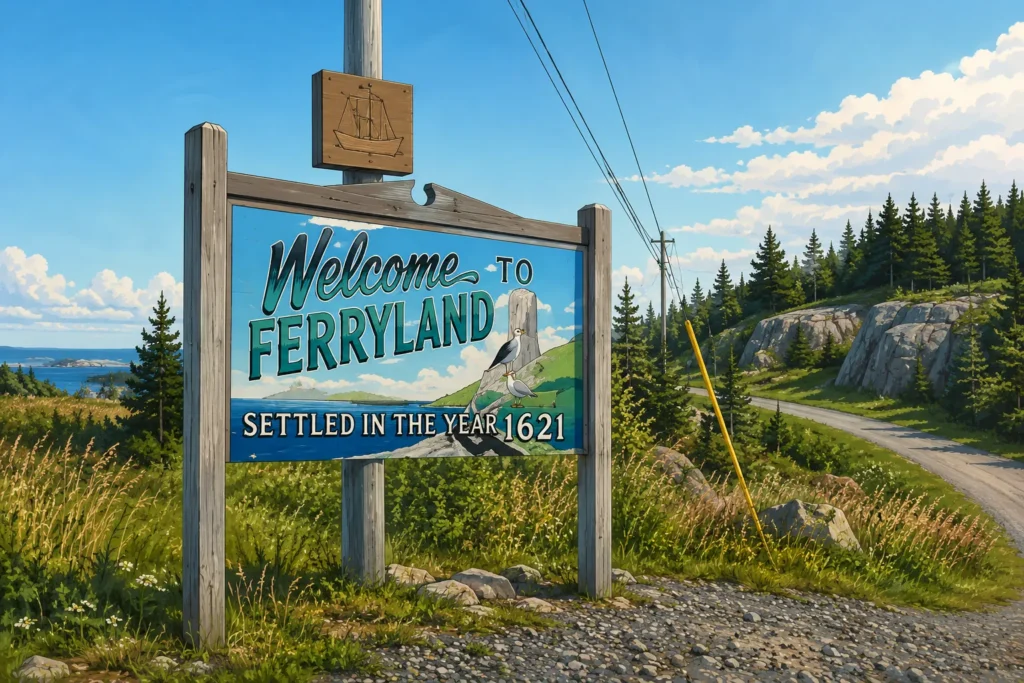
There are few places in Newfoundland and Labrador where the past feels quite as close as it does in Ferryland.
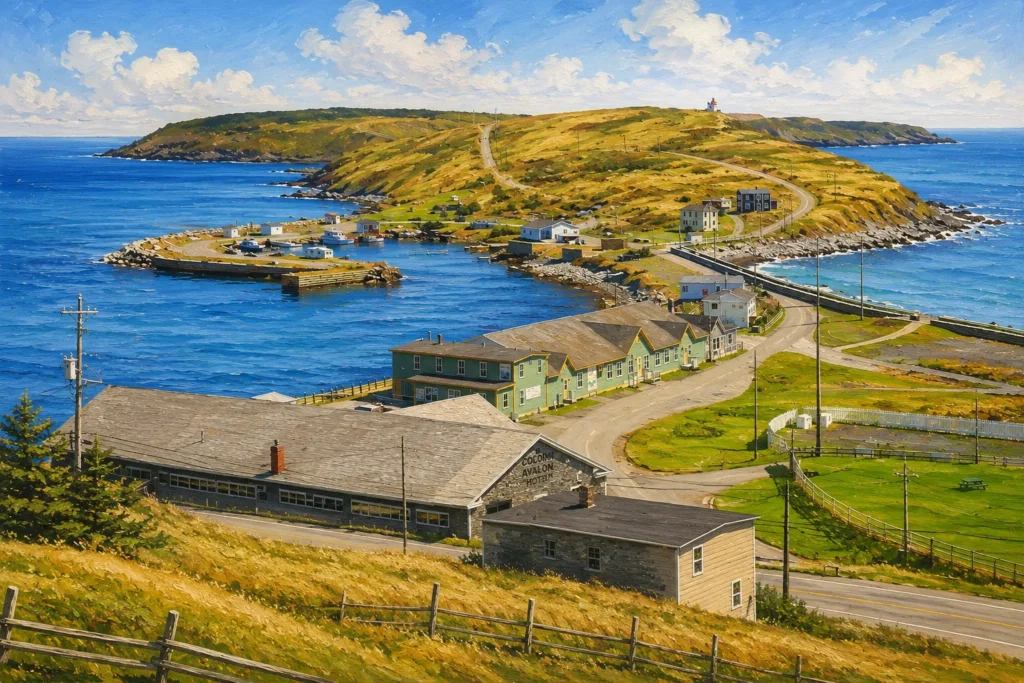
Stand beside the sheltered waters known simply as “The Pool,” Ferryland’s protected inner harbour, and it is easy to imagine sails appearing over the horizon. The salt air still carries the scent of the Atlantic. Fishing boats continue to work the harbour. Beneath the grassy fields and quiet walking trails, however, lies a story that stretches back more than four centuries—one that has reshaped historians’ understanding of early English settlement in North America.
Just one year after Plymouth was founded in New England, and about fourteen years after Jamestown was established, Ferryland became home to one of England’s earliest permanent colonial experiments in North America.
Today, the Colony of Avalon National Historic Site stands as one of Newfoundland and Labrador’s greatest historical treasures, revealing not only how people survived here, but how they built a thriving community in one of the world’s most challenging environments.
A Harbour Worth Crossing an Ocean For
Ferryland’s appeal was obvious long before permanent settlers arrived.
For centuries, European fishing crews from Portugal, France, Spain, the Basque Country, and England crossed the Atlantic each summer to harvest the rich cod stocks off Newfoundland. Archaeological evidence has also shown that Beothuk people used the Ferryland area before permanent English settlement, adding another important chapter to the region’s long human history.
The harbour itself offered rare advantages: deep, protected waters, plentiful fresh water, nearby forests for timber, and access to some of the richest fishing grounds anywhere in the North Atlantic.
Those qualities caught the attention of Sir George Calvert.
Lord Baltimore’s Newfoundland Dream
In 1620, Calvert purchased a large tract of land on Newfoundland’s Avalon Peninsula from Sir William Vaughan. Three years later, in 1623, the Crown formally confirmed the grant as the Province of Avalon, giving Calvert authority to establish a permanent English colony.
Unlike many earlier ventures that focused almost entirely on seasonal fishing, Calvert envisioned something much more ambitious: a permanent settlement that would grow into a year-round community where families could build new lives.
The first settlers, led by Governor Captain Edward Wynne, arrived in August 1621. Wynne and eleven labourers and tradesmen began constructing the colony, with women and children following over the next several years as the settlement gradually evolved into a permanent community.
They wasted little time.
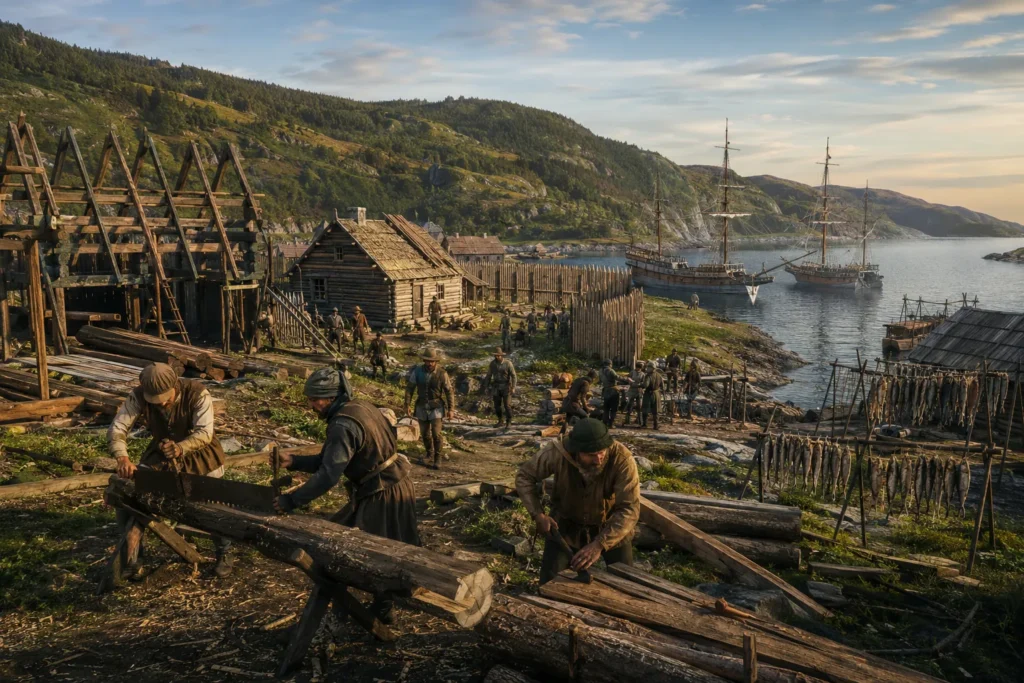
Over the next several years, workers constructed a substantial mansion house, storehouses, workshops, kitchens, defensive palisades, a forge, brewing facilities, gardens, and other essential buildings. Rather than creating a temporary fishing station, they were laying out the foundations of an organized English town designed to endure Newfoundland’s harsh winters.
Calvert first visited Ferryland in 1627 before returning with his family in 1628 to oversee the colony personally. After enduring a difficult winter, he departed in 1629 and turned his attention toward establishing a new colony in Maryland, where the Baltimore name would become even more famous.
A Surprisingly Sophisticated Settlement
Modern visitors are often surprised by what archaeologists have uncovered.
This was no rough collection of crude wooden huts.
Excavations have revealed carefully planned streets, substantial stone and timber buildings, waterfront infrastructure, workshops, imported ceramics, glassware, luxury items, and evidence of a community connected to international trade networks. Archaeological discoveries have demonstrated that Ferryland was among the most sophisticated early English colonial settlements in North America and is widely regarded as one of the best-preserved early English colonial archaeological sites on the continent.
Perhaps even more remarkable is what the site reveals about everyday life.
Excavated artifacts include children’s toys, writing tools, cooking vessels, tobacco pipes, clothing accessories, religious objects, and thousands of household items. To date, archaeologists have recovered more than two million artifacts from the site, each helping to reconstruct the daily lives of the people who lived here.
History becomes wonderfully personal when viewed through these ordinary possessions.
A Colony That Changed Hands
Calvert’s dream was not destined to remain under his family’s control.
After he left Newfoundland, the settlement eventually came under the leadership of Sir David Kirke, one of the most influential figures in early Newfoundland history. During this period, Ferryland became known as the Pool Plantation and served as the administrative centre of English Newfoundland from 1637 to 1650. Because of this role, it is often described as a de facto capital of English Newfoundland, although it was never officially designated as the colony’s capital.
The colony prospered for decades despite political upheaval, harsh weather, and conflict between European powers.
Its fortunes changed dramatically in 1696 when French forces attacked Ferryland during the Avalon Peninsula Campaign, devastating much of the seventeenth-century settlement. Many residents were forced into exile in Devon, England, although some returned the following year to rebuild. While Ferryland continued as a community, the attack marked the end of the original Colony of Avalon’s most significant period.
History Hidden Beneath the Grass
For generations, local residents occasionally unearthed fragments of pottery, glass, and other mysterious objects while gardening or digging foundations.
Everyone knew Ferryland had an extraordinary past.
What remained unknown was the true scale, layout, and remarkable state of preservation hidden beneath the ground.
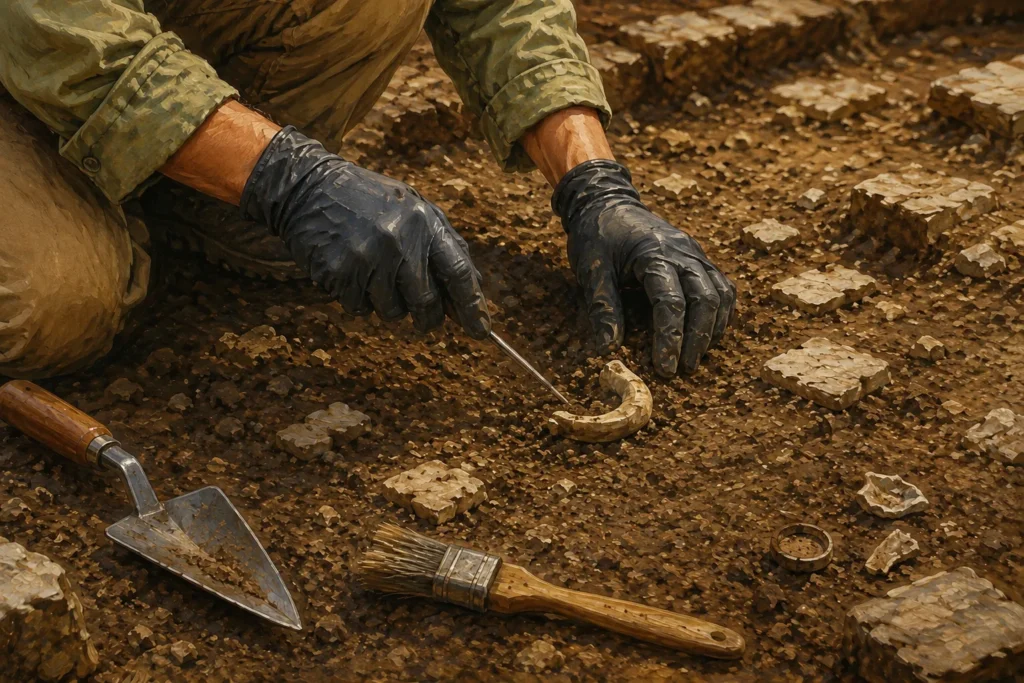
Although historians and archaeologists began identifying the colony’s remains during investigations in the late 1980s and early 1990s, the modern archaeological excavation began in 1992. Guided by archival research, historical records, and the knowledge of local residents, decades of excavation have transformed Ferryland into one of Canada’s most important archaeological sites.
Each excavation season continues to reveal new discoveries.
The earliest layers have uncovered evidence of both Beothuk activity and sixteenth-century European seasonal fishing crews, illustrating that Ferryland’s history stretches back well before the arrival of permanent English settlers.
Every shard of pottery, rusted nail, clay pipe fragment, or stone foundation helps historians better understand the lives of the people who built one of England’s earliest enduring colonial communities in North America.
Remarkably, the story is still being written.
Walking Through Four Centuries
Few historic places allow visitors to stand where history is actively being uncovered.
At the Colony of Avalon, guests can watch archaeologists at work during excavation season, explore reconstructed gardens growing heritage crops, walk beside the original waterfront, and view artifacts recovered directly from the site. It is a rare opportunity to witness history moving from the soil into museum displays in real time.
More than 400 years after the first settlers arrived, Ferryland continues to surprise researchers and visitors alike. Recent discoveries—including seven rare wampum beads, the first ever found in Newfoundland and Labrador—are providing new insights into Indigenous-European interactions and demonstrate that the site still has important stories to tell.
Its quiet shoreline reminds us that Newfoundland and Labrador was never merely a stopping point for explorers. It was a place where people built homes, raised families, defended their community, and helped shape the earliest chapters of English colonial history in what would eventually become Canada.
Have you ever visited the Colony of Avalon or explored Ferryland? We’d love to hear your memories, see your photographs, or read your family stories about this remarkable place. Share them in the comments and help celebrate one of Newfoundland and Labrador’s most fascinating historic communities.
If you enjoyed this story, be sure to read more fascinating Newfoundland and Labrador stories here on ShareNL.ca