From storm-battered steamships to wartime freighters resting beneath Conception Bay, Newfoundland’s shipwrecks tell stories not only of disaster, but of courage, community and an enduring relationship with the sea.
On a grey Newfoundland morning, the ocean can seem to erase the horizon. Fog settles against the cliffs, seabirds vanish into the mist, and the steady Atlantic swell rolls toward a coastline carved into coves, headlands, islands and reefs. From shore, there may be little to suggest what lies beneath.
But Newfoundland’s waters hold the remains of generations of ships.
Some were driven onto rocks by winter gales. Others disappeared in fog or darkness. Some carried passengers, fishermen and freight between isolated communities. During the Second World War, others were deliberately sent to the bottom by enemy torpedoes.
Together, these wrecks form an extraordinary underwater record of Newfoundland’s maritime past — a history in which tragedy is inseparable from remarkable stories of survival and rescue.
An Island Shaped by the Sea
For centuries, ships were Newfoundland’s highways.
Before roads connected much of the island, schooners and coastal steamers carried people, food, mail and supplies from community to community. Fishing vessels worked offshore grounds while ocean-going ships passed Newfoundland on voyages between Europe and North America.
The same geography that made Newfoundland important to Atlantic navigation also made its coast dangerous. Fog, reefs, powerful seas, winter ice and rapidly changing weather could turn an ordinary passage into an emergency.
The Shipwreck Preservation Society of Newfoundland & Labrador maintains records of wrecks scattered around the province, documenting vessels ranging from small schooners to passenger steamers and wartime freighters. Their stories span centuries.
Yet numbers and wreck locations reveal only part of the history. Again and again, the most memorable chapters begin after a ship strikes the rocks — when somebody on shore realizes lives are in danger.
Isle aux Morts: A Family Runs Toward the Storm
One of Newfoundland’s greatest rescue stories unfolded at Isle aux Morts in 1828.
The immigrant ship Despatch was wrecked on offshore reefs during a hurricane. According to the Heritage Foundation of Newfoundland and Labrador, George Harvey, his 17-year-old daughter Ann and 12-year-old son Tom helped rescue more than 150 people from the stricken vessel.
It was an astonishing act of courage.
George Harvey received recognition from the Royal Humane Society of Great Britain, but the family’s story did not end there. Ten years later, the Harveys again participated in a maritime rescue when the Rankin was wrecked, saving another 25 men.
Today, Ann Harvey remains one of Newfoundland and Labrador’s most celebrated figures of maritime heroism. Her story captures something found repeatedly in the province’s shipwreck history: when strangers appeared in mortal danger offshore, coastal residents often became rescuers.
The Florizel: Disaster Near Cappahayden
Nearly a century later, Newfoundland was shaken by another tragedy.
The Florizel was no anonymous vessel. Built in Scotland in 1909, she had served Newfoundland as a passenger ship, sealing vessel and wartime troop carrier. In October 1914, she carried members of the Newfoundland Regiment overseas.
Then came February 24, 1918.
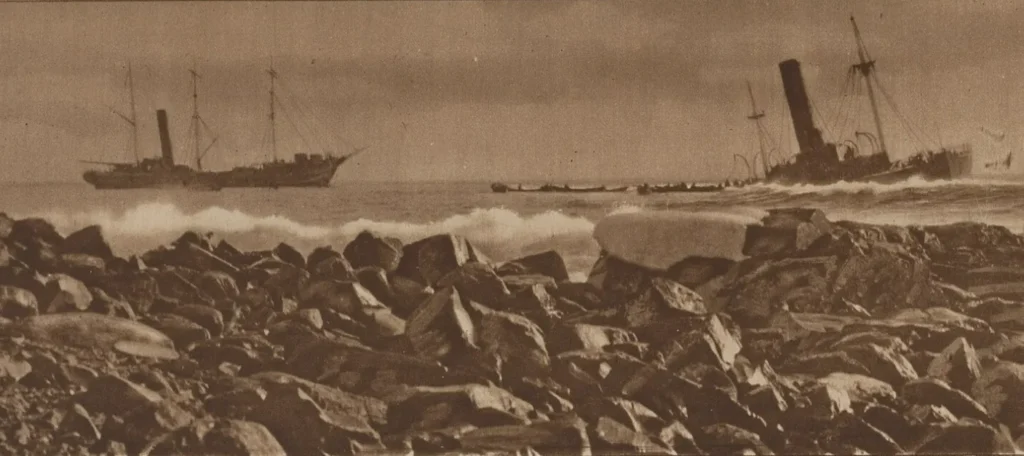
After leaving St. John’s for Halifax and New York, the Florizel encountered severe winter weather. Navigation became difficult, and the ship struck rocks near Cappahayden on Newfoundland’s Southern Shore.
Memorial University’s Maritime History Archive records 138 people aboard. Only 44 survived.
The wreck became one of the most haunting maritime disasters in Newfoundland history. Contemporary records and later recollections describe enormous seas breaking over the vessel while rescuers struggled to reach survivors stranded frighteningly close to shore.
The Florizel had crossed the Atlantic and carried Newfoundland soldiers toward war. Yet her final voyage ended against the rocks of home.
The Ethie: A Wreck Where Everyone Lived
Not every Newfoundland shipwreck became a story of mass loss.
At Martin’s Point on the west coast, pieces of rusted machinery still lie along the shore within what is now Gros Morne National Park. They are remnants of the SS Ethie, a Reid Newfoundland Company coastal steamer lost on December 11, 1919.
Caught in a violent storm, the Ethie went ashore at Martin’s Point. The Shipwreck Preservation Society records 92 people aboard — 60 passengers and 32 crew.
Every one survived.
A line was established between ship and shore and passengers were brought across using a boatswain’s chair. A small child was famously transported to safety in a mailbag.
The rescue also produced one of Newfoundland’s enduring shipwreck legends: that a heroic dog carried a line ashore. Accounts of a dog’s role have changed considerably over time, and modern retellings have challenged parts of the popular version. What is documented is remarkable enough without embellishment: amid a December storm, local residents and the ship’s crew helped bring every person aboard to safety.
More than a century later, Parks Canada visitors can descend toward the beach and see remains of the Ethie scattered among the stones.
History is not behind glass here. It is rusting beside the Atlantic.
When War Entered Conception Bay
Perhaps Newfoundland’s most extraordinary underwater wreck site lies off Bell Island.
In 1942, Newfoundland was still a separate Dominion and an important Allied base in the Battle of the Atlantic. Bell Island’s iron ore was strategically valuable to wartime steel production.
German submarines came looking for it.
On September 5, German U-boat U-513 attacked ships near Bell Island, sinking the SS Saganaga and SS Lord Strathcona. Two months later, on November 2, U-518 entered Conception Bay and attacked again, sinking the SS Rose Castle and the Free French vessel PLM 27. A torpedo also struck Scotia Pier.
Seventy merchant mariners died in the two attacks, according to Parks Canada.
For Bell Islanders, the Battle of the Atlantic was suddenly not a distant struggle reported from overseas. War had entered their harbour.
The four wrecks remain on the bottom of Conception Bay at depths of roughly 25 to 45 metres. They have become internationally known diving sites, but they are also graves and places of remembrance. Canadian military divers later removed approximately 200 pieces of wartime ammunition from the wrecks during unexploded-ordnance work conducted in 2019 and 2021.
The German U-boat attacks at Bell Island were designated a national historic event in 2019.
St. Lawrence and Lawn: Rescue in a February Sea
The same year brought another catastrophe to Newfoundland’s south coast.
On February 18, 1942, the American destroyer USS Truxtun and supply ship USS Pollux were lost during a winter storm near St. Lawrence and Lawn while travelling toward the American naval base at Argentia.
Of 389 men aboard the two vessels, 203 died.
The survival of the other 186 was due in large measure to residents of St. Lawrence and Lawn, who helped pull exhausted and injured sailors from an unforgiving winter sea and provided shelter afterward.
The wreck sites are considered war graves.
Once again, Newfoundland’s shipwreck history became a story about what happened on land as much as what happened at sea.
Ordinary people became rescuers because there was nobody else to do it.
More Than Wreckage Beneath the Waves
It is tempting to think of shipwrecks as ships frozen at the moment they sank. In reality, wreck sites continue to change. Salt water, currents, storms, corrosion and marine life slowly transform them.
Their stories change too.
Facts become family stories. Family stories sometimes become folklore. Songs are written, monuments erected, artifacts preserved and names passed from one generation to another.
That makes careful preservation especially important. A shipwreck is not simply an interesting object on the seabed. It can be an archaeological site, a workplace lost in disaster, evidence of international conflict and, in some cases, the final resting place of people who never returned home.
To stand on Newfoundland’s coast knowing a wreck lies somewhere beyond the breakers is to see the ocean differently.
The water stops looking empty.
Why It Matters Today
Newfoundland’s shipwrecks remind us how completely the sea shaped life here. They tell of danger and loss, certainly, but they also preserve something deeply human: the instinct of coastal people to help when somebody offshore was in trouble.
From Ann Harvey at Isle aux Morts to the rescuers of the Ethie, the Florizel, the Truxtun and the Pollux, these stories belong not only to maritime history but to community history.
The ships may be disappearing slowly beneath waves, rust and stone, but their stories do not have to disappear with them. Remembering them gives us another way to understand Newfoundland — not simply as an island surrounded by an ocean, but as a place whose identity was forged through generations of living with it.
Do You Have a Shipwreck Story?
Almost every stretch of Newfoundland coastline seems to have a story connected to the sea. Perhaps your community has a wreck known mostly to local residents. Maybe an ancestor participated in a rescue, survived a sinking, worked aboard a coastal steamer or told stories about wreckage that once washed ashore.
We’d love to hear those stories.
Share your memories, family photographs, local knowledge and shipwreck stories in the comments. Together, they can help preserve pieces of Newfoundland and Labrador history that may never appear in an official archive.
History lives through the stories we share.
If you enjoyed this story, be sure to read more fascinating Newfoundland and Labrador stories here on ShareNL.ca.