
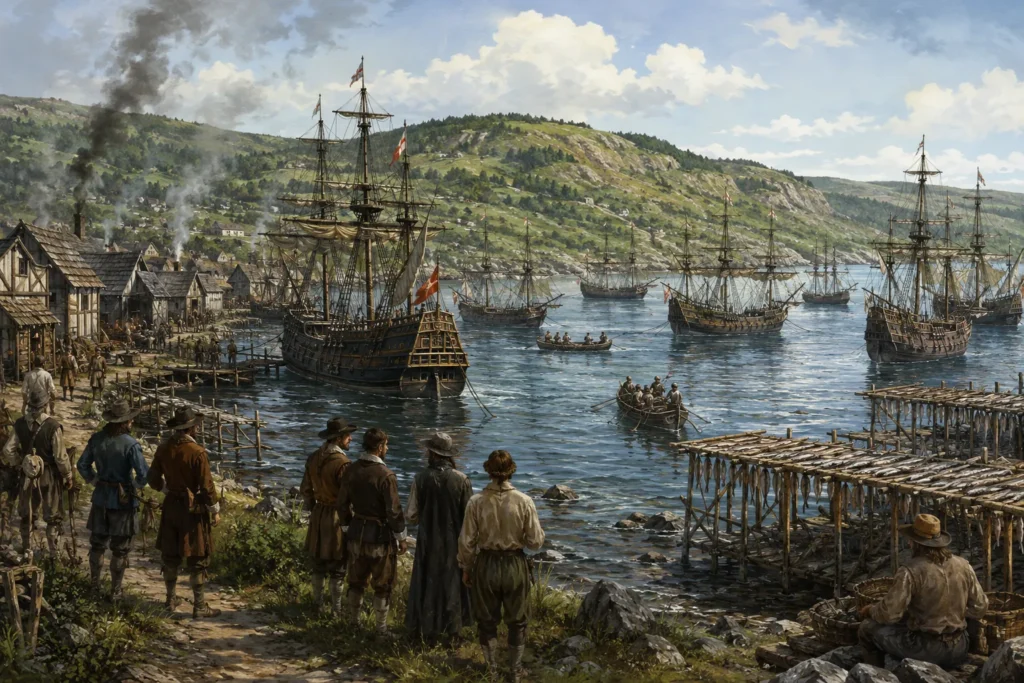
Long before the exploits of Blackbeard, Captain Kidd, and the swashbuckling pirates of popular fiction, Newfoundland’s rugged coastline found itself at the centre of a very real pirate empire.
During the early seventeenth century, the island’s sheltered harbours, thriving seasonal fishery, and limited government oversight created ideal conditions for ambitious sea raiders. Among them was Peter Easton, an English privateer turned pirate whose powerful fleet transformed Harbour Grace into one of the most formidable pirate headquarters in the North Atlantic.
For a brief but extraordinary period, piracy was not merely an occasional danger offshore. It became a serious threat to Newfoundland’s fishery, its earliest English settlements, and the merchants whose fortunes depended upon the rich waters surrounding the island.
Today, Harbour Grace is known for its beautiful harbour, rich aviation history, and centuries-old streets. Four hundred years ago, however, it briefly became one of the most feared pirate bases in the Atlantic world.
A Harbour Filled with Pirate Ships
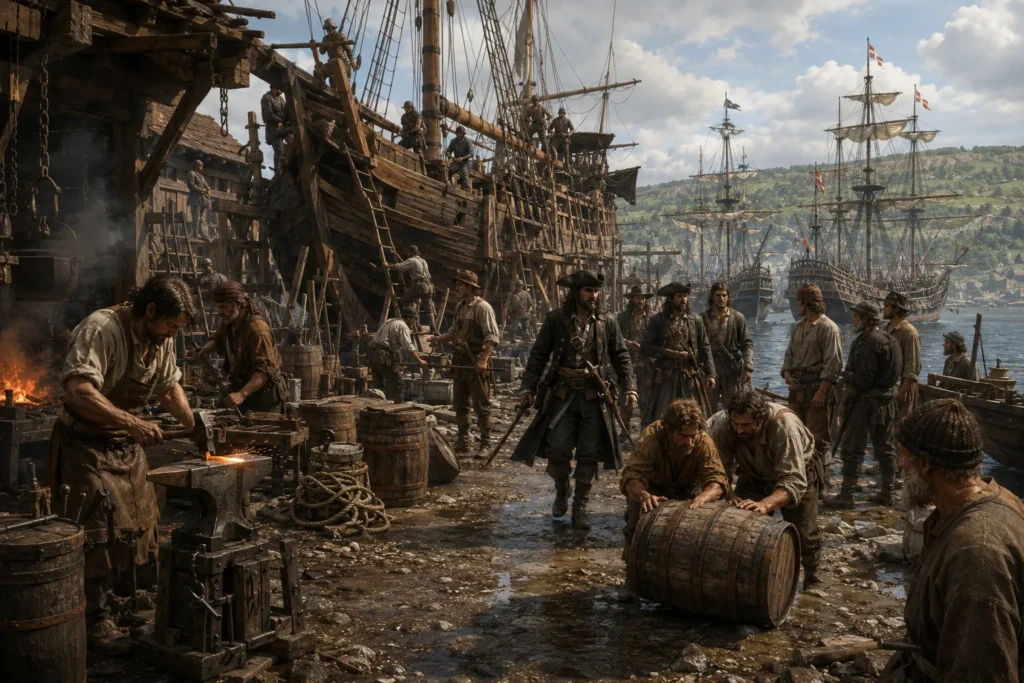
Imagine standing on the shoreline of Harbour Grace during the summer of 1612.
Instead of peaceful fishing boats, the harbour is crowded with heavily armed ships undergoing repairs. Sailors haul barrels of provisions ashore while blacksmiths, carpenters, and shipwrights labour to prepare vessels for another voyage. Local fishing crews watch uneasily as pirates demand food, ammunition, equipment, and experienced seamen to strengthen their growing fleet.
This was no scene from a novel.
Contemporary letters written by John Guy, governor of the nearby English colony at Cupids, describe Peter Easton’s fleet repairing ships at Harbour Grace, commandeering skilled tradesmen, taking provisions, and recruiting men from surrounding fishing stations. His correspondence provides one of the most valuable firsthand accounts of Newfoundland’s pirate era.
For one remarkable season, Harbour Grace became the operational headquarters of one of the most formidable pirate fleets of the early seventeenth century.
Newfoundland: A Pirate’s Perfect Opportunity
To understand why pirates came to Newfoundland, it helps to understand what the island represented in the early 1600s.
Every spring and summer, fleets crossed the Atlantic to harvest cod from the Grand Banks. By this time, English and French vessels dominated the fishery, although Portuguese, Spanish, and Basque fishermen had helped establish the transatlantic cod trade generations earlier.
The seasonal fishery generated enormous wealth.
Hundreds of ships arrived carrying food, salt, fishing equipment, sails, rope, tools, weapons, timber, and other valuable supplies needed to support months at sea. The fish they carried home supplied markets across Europe.
Yet despite its economic importance, Newfoundland remained lightly governed.
Permanent settlements were few, military defences were limited, and enforcing English law along hundreds of kilometres of rugged coastline proved extremely difficult. Naval protection was inconsistent, leaving isolated fishing stations and merchant vessels vulnerable.
For pirates, the opportunity was obvious.
Unlike the romantic image of searching for buried treasure, Newfoundland offered something far more practical. A pirate who controlled the fishery could acquire ships, provisions, weapons, skilled craftsmen, navigational knowledge, and experienced sailors—everything needed to sustain operations across the North Atlantic.
Peter Easton: From Privateer to Pirate
No pirate became more closely associated with Newfoundland than Peter Easton.

Easton appears to have begun his career as an English privateer operating under royal authority during the reign of Queen Elizabeth I. Privateers were legally commissioned to attack enemy shipping during wartime, and Easton was at one point entrusted with protecting England’s Newfoundland fishing interests.
Everything changed after England made peace with Spain under King James I.
As commissions expired and privateering lost its legal protection, Easton continued attacking ships. What had once been sanctioned warfare increasingly became piracy.
By 1612, he had established Harbour Grace as his principal Newfoundland base.
Historical accounts differ slightly regarding the size of his fleet. Richard Whitbourne later recalled Easton arriving with ten well-equipped ships, while John Guy counted six ships under his immediate command at Harbour Grace during the summer of 1612. Regardless of the exact number, there is little doubt that Easton’s fleet was among the strongest operating in Atlantic waters at the time.
From Harbour Grace, Easton and his captains ranged widely along Newfoundland’s coast, from Trinity Bay to Ferryland, intercepting vessels, taking supplies, and strengthening their fleet.
According to historical records, Easton plundered thirty English ships in St. John’s harbour. John Guy also reported that Easton had already taken approximately one hundred men from Conception Bay and intended to leave Newfoundland with as many as five hundred recruits. Some undoubtedly joined for the promise of profit and adventure, while others were forced into service.
Easton’s growing power became impossible to ignore.
Unlike many famous pirates who eventually died in battle or at the gallows, he accumulated enormous wealth while repeatedly avoiding capture.
Eventually, Easton accepted the protection of the Duke of Savoy, settled at Villefranche on the Mediterranean coast, acquired wealth and social standing, and disappears from the historical record after about 1620. His remarkable career has led many historians to regard him as one of the most successful pirates of his generation.
Richard Whitbourne and an Unusual Encounter
Among those who crossed paths with Easton was Richard Whitbourne, the experienced mariner, merchant, and colonial promoter who would later be knighted.
Easton captured Whitbourne and held him for eleven weeks.
Rather than simply demanding ransom, Easton reportedly attempted to persuade Whitbourne to join the pirate enterprise, promising both wealth and influence.
Whitbourne refused.
Instead, he encouraged Easton to seek a royal pardon and agreed to help secure one. Upon returning to England, however, Whitbourne discovered that a pardon had already been issued earlier but had never reached Easton. The episode illustrates the surprisingly complicated relationship between piracy and government authority during the early seventeenth century.
The View from Cupids
While Whitbourne experienced piracy firsthand, John Guy documented it from the perspective of Newfoundland’s first permanent English colony.
Founded in 1610, Cupids represented England’s ambitious attempt to establish a year-round settlement on the island. Guy’s surviving letters reveal the constant uncertainty facing the colony as Easton’s fleet operated nearby.
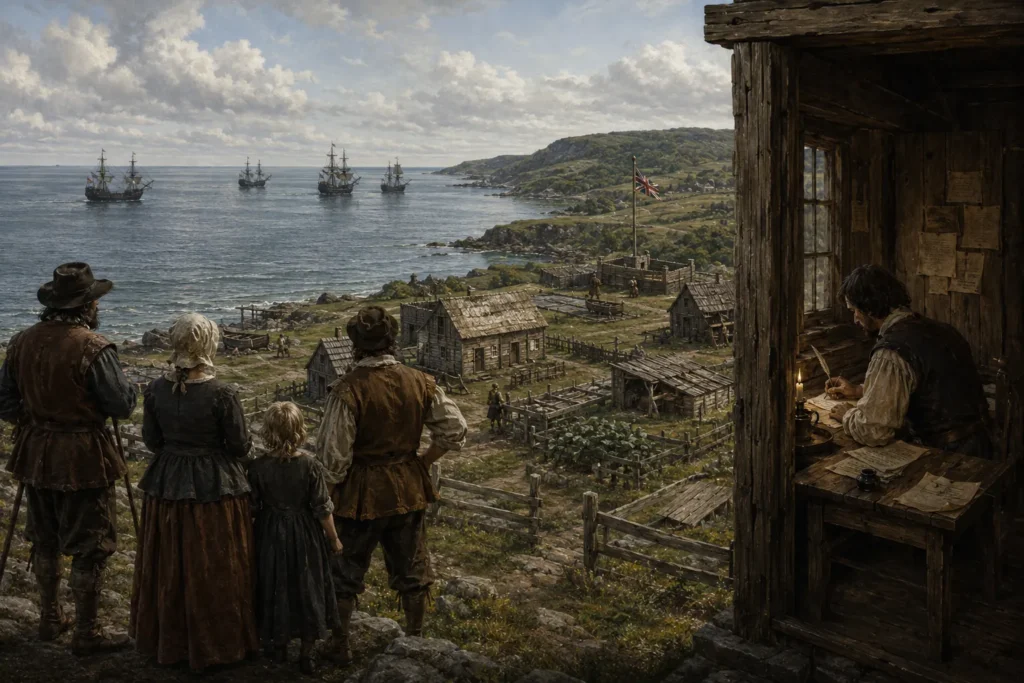
He described pirates repairing ships at Harbour Grace, commandeering carpenters, seizing food, powder, ammunition, and other supplies, while recruiting men from fishing stations throughout Conception and Trinity bays.
Although Easton’s activities caused understandable alarm, the colony itself escaped major destruction. Instead, the settlers found themselves navigating an uneasy coexistence with a pirate fleet whose military strength far exceeded anything they could hope to challenge.
Today, Guy’s correspondence remains one of the most important primary sources for understanding Newfoundland’s early colonial history and pirate activity.
Another Pirate Follows: Henry Mainwaring
Peter Easton was not the only notorious pirate to recognize Newfoundland’s strategic importance.
Within a few years of Easton’s departure, another English seaman turned pirate—Henry Mainwaring—also made Newfoundland part of his operations. Like Easton, Mainwaring had begun his career under legitimate authority before turning to piracy during the turbulent years that followed England’s peace with Spain.
Mainwaring quickly recognized the same advantages that had attracted Easton. Each summer, Newfoundland’s harbours filled with valuable fishing ships carrying provisions, equipment, and experienced crews. Rather than searching for mythical treasure, pirates could obtain nearly everything they needed simply by preying upon the seasonal fishery.
Unlike Easton, however, Mainwaring’s story took a remarkable turn.
He eventually accepted a royal pardon from King James I, abandoned piracy, and entered royal service. Around 1618, he completed A Discourse of Pirates, one of the earliest and most influential studies of piracy ever written. Drawing upon his own experience, Mainwaring analyzed pirate tactics, recruitment, leadership, and the measures governments should adopt to suppress them.
The careers of Easton and Mainwaring demonstrate that Newfoundland’s pirate era was not the work of a single notorious outlaw. During the early seventeenth century, the island’s strategic location and immensely valuable fishery attracted some of Europe’s most capable sea raiders and helped convince English authorities that stronger colonial government and greater naval protection were essential.
The Truth About Pirate Treasure
Popular culture has taught us to picture pirates burying chests of gold beneath lonely beaches and marking secret maps with a large red “X.”
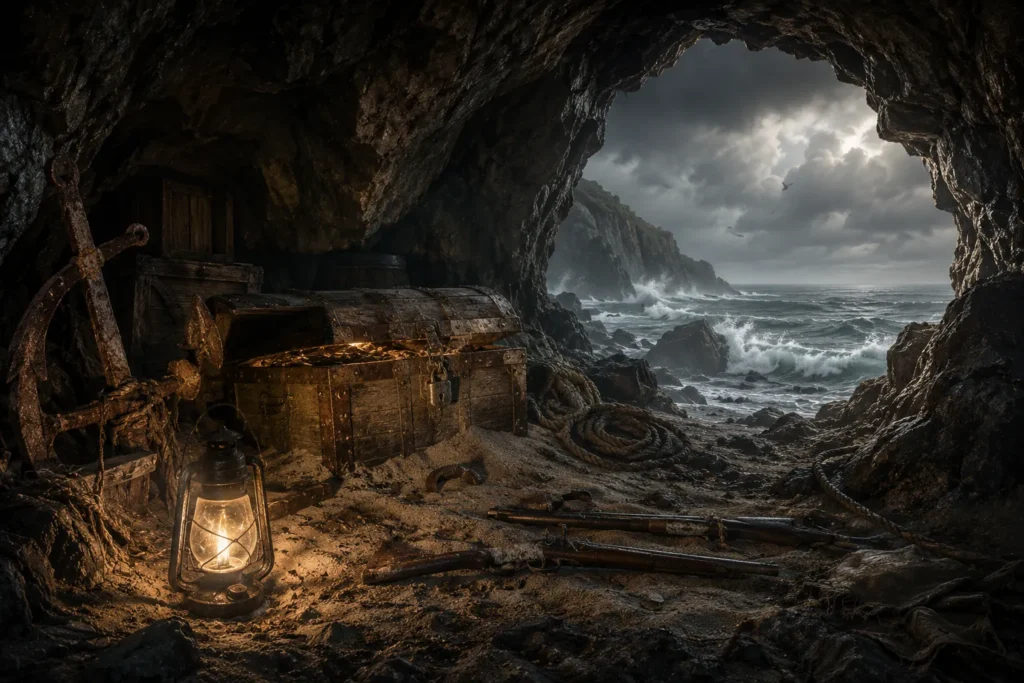
Newfoundland’s pirates were interested in something much more practical.
Their greatest prizes were ships, food, fishing equipment, weapons, sails, rope, navigational instruments, and experienced crews. These resources allowed pirate fleets to repair vessels, replenish supplies, recruit skilled sailors, and continue operating across the Atlantic.
That has not stopped the legends.
For generations, stories of buried pirate treasure have circulated throughout Newfoundland and Labrador. Hidden coves, isolated islands, sea caves, and rocky headlands have all inspired local folklore linking them to forgotten pirate caches.
Despite their enduring appeal, historians have found very little documentary evidence supporting such tales. Most are best understood as colourful pieces of Newfoundland’s rich storytelling tradition rather than established historical fact.
Yet these legends continue to add an irresistible layer of mystery to communities already steeped in maritime history.
A Legacy That Still Echoes Along the Coast
Today, Harbour Grace bears little resemblance to the vulnerable seasonal harbour Peter Easton once exploited.
Fishing boats still leave before dawn. Historic churches overlook the waterfront. Visitors explore museums, heritage buildings, and quiet streets that preserve more than four centuries of history.
Few would imagine that this peaceful community once stood at the centre of an international struggle involving commerce, empire, piracy, and the future of England’s Atlantic ambitions.
Peter Easton’s occupation of Harbour Grace lasted only a short time, but its impact reached far beyond Newfoundland. His success exposed the vulnerability of the North Atlantic fishery, challenged English authority, and highlighted the need for stronger colonial administration. Together with the later activities of Henry Mainwaring and other sea raiders, Easton’s career became part of the story that shaped England’s evolving approach to governing Newfoundland.
Long before the romantic age of pirate fiction, Newfoundland’s coastline briefly served as the operational base for some of the Atlantic world’s most formidable pirates. Their story remains one of the most fascinating—and often overlooked—chapters in the province’s remarkable maritime history.
Have you ever visited Harbour Grace or another Newfoundland community connected with pirate history? Have you heard family stories or local legends about pirates, hidden treasure, or mysterious coastal caves? Share your memories, photographs, and stories in the comments—we’d love to hear them.
If you enjoyed this story, explore more fascinating stories about Newfoundland and Labrador’s history, culture, folklore, and remarkable people here on ShareNL.ca.



Do you have any information on Pirate Kelly and Kelly’s Island in Conception Bay? Nobody seems to know much about him and I cannot find anything on him either. Thank you!
Thanks for asking! We actually started digging into this after writing the article because we were curious too.
The interesting thing is that there appears to be very little documented historical evidence that Captain Kelly was a real person. Most of what we know comes from local tradition and folklore, not surviving colonial records.
According to the Encyclopedia of Newfoundland and Labrador, Kelly’s Island is traditionally said to have been named after a 17th-century Cornish pirate who supposedly used the island as a rendezvous point. Local legend also says he buried treasure there, and some stories even claim it was secretly recovered around 1920. However, there are no known contemporary records that confirm Captain Kelly himself or these events.
Historians generally consider Pirate Kelly to be part of Newfoundland folklore rather than established history. It’s also possible that the legend became intertwined with the very real pirate activity of Peter Easton, who is well documented in Conception Bay around 1611–1612 and is known to have used Kelly’s Island as a strategic base. Over the centuries, stories may have merged or evolved.
We’ve become intrigued by the mystery as well, and we plan to do a deeper dive into Kelly’s Island to see whether any overlooked records, newspaper accounts, family histories, or archival documents can shed more light on the legend. If we uncover anything substantial, we’ll definitely turn it into a ShareNL feature!