How a magnificent stone estate overlooking Harbour Grace became the social heart of nineteenth-century Newfoundland—and why its haunting ruins still capture the imagination today.
Few places in Newfoundland carry the quiet grandeur of Ridley Hall.
Even in ruin, its weathered stone walls rise above Harbour Grace with remarkable dignity, overlooking one of North America’s oldest ports much as they have for nearly two centuries. Ivy clings to broken masonry where elegant windows once reflected the waters of Conception Bay. Empty openings now frame the sky instead of glittering chandeliers, while winds that once carried the laughter of governors, merchants, and distinguished guests sweep through silent rooms exposed to the elements.
Today, many travellers slow their cars as they pass the remains, wondering what stories those walls could tell.
The answer reaches far beyond one remarkable house. Ridley Hall is the story of Newfoundland during its greatest age of mercantile wealth—a period when Harbour Grace rivalled St. John’s as one of the colony’s busiest ports, fortunes were made in the cod and seal fisheries, and a magnificent mansion became a symbol of prosperity, influence, and ambition. Its rise mirrored the extraordinary success of one of Newfoundland’s most powerful merchant families, while its decline reflected the economic upheavals that transformed an entire colony.
A Mansion Built for Success
When Thomas Ridley arrived in Newfoundland during the early nineteenth century, Harbour Grace was already emerging as one of the island’s commercial powerhouses. Located on the sheltered waters of Conception Bay, the town occupied a strategic position in the Atlantic fish trade. Ships crowded the harbour each season, carrying dried cod to markets across Europe, the Caribbean, and South America before returning with manufactured goods and supplies that fuelled the colony’s expanding economy.
Ridley quickly established himself as one of the community’s most successful fishing and sealing merchants. Through determination, careful business dealings, and a willingness to invest in new opportunities, his company grew into one of Newfoundland’s largest mercantile firms. By the 1830s, his prosperity demanded a residence worthy of both his wealth and his standing within colonial society.
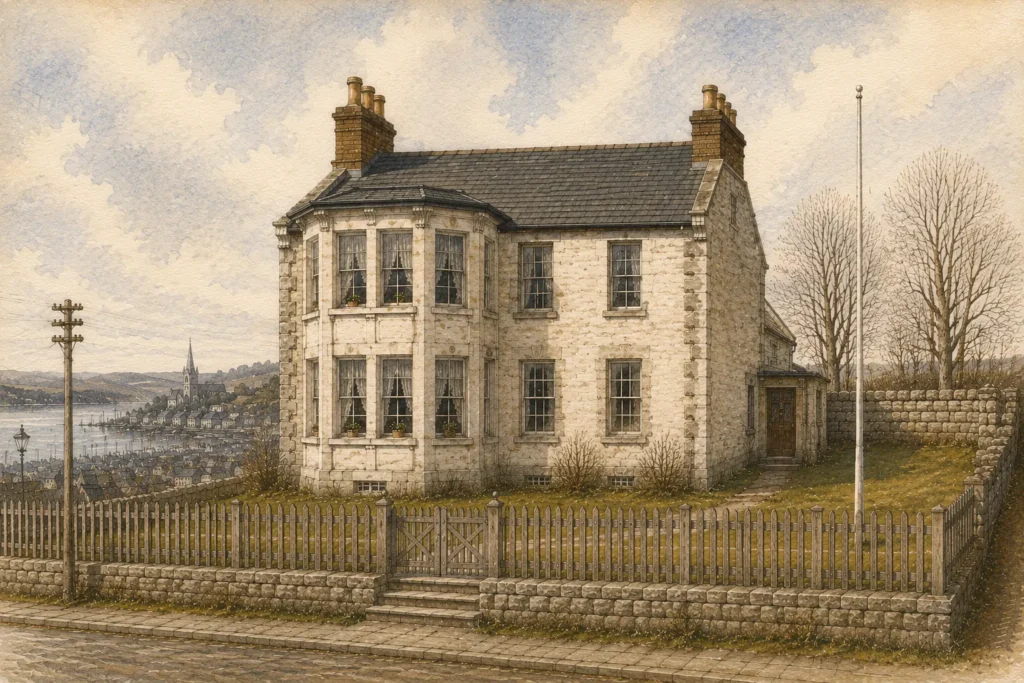
Construction of Ridley Hall began in 1834 along Water Street, where the mansion overlooked both the harbour and the bustling commercial district below. Rather than following the simpler wooden architecture common throughout much of Newfoundland, Ridley chose permanence. Local bluestone formed the massive exterior walls, complemented by imported brick, sandstone details, and an elegant slate roof. The result was one of the colony’s most impressive private residences and one of the finest stone houses ever constructed in Newfoundland.
The house reflected the confidence of a merchant who expected both his business and his family legacy to endure for generations. Its commanding position allowed visitors arriving by sea to see the mansion long before stepping ashore, making Ridley Hall an unmistakable landmark that proclaimed Harbour Grace’s prosperity to every incoming vessel.
Harbour Grace at the Height of Its Glory
To understand Ridley Hall is to understand Harbour Grace during the middle decades of the nineteenth century.
Long before Confederation, the town stood among Newfoundland’s busiest commercial centres. Wharves stretched into the harbour, warehouses overflowed with fish and imported goods, and hundreds of schooners crowded the waterfront during the fishing season. Merchants, shipbuilders, craftsmen, labourers, and sailors filled the narrow streets with constant activity, while the fortunes generated by the fishery supported a surprisingly sophisticated social life.
The merchant elite competed not only through commerce but also through architecture, philanthropy, and public life. Elegant homes, churches, schools, and commercial buildings transformed the waterfront into one of British North America’s most prosperous communities outside its largest cities. Ridley Hall became perhaps the finest expression of that prosperity.
Thomas Ridley’s influence extended well beyond business. He served in Newfoundland’s House of Assembly and later on the Executive Council, although his political career was often turbulent. Historical records describe fierce election campaigns marked by intimidation and violence, reflecting the passionate political divisions of the era. Despite these setbacks, Ridley remained among the colony’s most influential public figures for decades.
His family also embraced innovation. Historical accounts credit the Ridleys with introducing gas lighting to Harbour Grace in 1854 and pioneering the use of a steamship in the local seal hunt a dozen years later. Thomas Ridley’s son, William, helped establish important civic institutions, including the Harbour Grace Water Company, the Harbour Grace Railway, and the town’s grammar school, further cementing the family’s role in shaping the community’s future.
The Grandest House in Newfoundland
Ridley Hall was never intended to be merely a comfortable family home.
It was designed as a stage upon which Newfoundland’s growing mercantile class could entertain with elegance equal to that found in Britain’s finest colonial centres. Sometime after the original construction, the family enlarged the mansion with an impressive ballroom addition. Doors from this grand entertaining space opened directly onto formal English gardens, where carefully planned landscaping contrasted dramatically with the rugged coastline beyond.
Inside, visitors encountered broad staircases, finely furnished reception rooms, imported decorative finishes, and interiors that reflected Victorian tastes for refinement and display. Although much of the original decoration disappeared long before the devastating fire of 2003, contemporary descriptions leave little doubt that Ridley Hall ranked among Newfoundland’s most luxurious private residences.
The mansion quickly became the centre of Harbour Grace’s social calendar. Governors, politicians, military officers, prominent merchants, and distinguished visitors regularly attended receptions and formal gatherings hosted by the Ridley family. Newspapers of the day devoted considerable attention to these occasions, recording the arrival of important guests and describing evenings filled with music, dancing, elaborate dinners, and conversation.
One event entered Newfoundland history.
In August 1855, Thomas Harrison Ridley hosted a spectacular ball that contemporary newspapers described as “the most brilliant entertainment that has ever taken place in Newfoundland.” Invitations were reportedly issued to around two hundred guests. Despite poor weather reducing attendance, governors, political leaders, and many of the colony’s most prominent families gathered beneath Ridley Hall’s roof for an evening remembered for its elegance and splendour.
Such occasions elevated Ridley Hall beyond the status of a private residence. It became a symbol of colonial confidence during a period when Newfoundland’s economy appeared capable of sustaining remarkable prosperity.
Perhaps no image captures that prestige more vividly than the long-standing custom of ships saluting Ridley Hall as they entered Harbour Grace. Passing captains recognized not simply a mansion but the home of one of Newfoundland’s most influential merchant families. The gesture reflected the immense respect—and sometimes awe—that Thomas Ridley commanded throughout the colony.
The grandeur that surrounded Ridley Hall, however, could not shield it from the changing fortunes of Newfoundland’s economy.
Like many merchant dynasties of the nineteenth century, the Ridley family’s prosperity depended upon industries that were vulnerable to fluctuating markets, changing trade patterns, and financial uncertainty. Although Thomas Ridley had built one of the colony’s most successful commercial empires, later generations faced increasing economic pressures. By the latter half of the nineteenth century, the family’s financial position had weakened considerably, and maintaining such an enormous estate became increasingly difficult. As fortunes declined, the mansion that had once symbolized limitless confidence gradually became an expensive reminder of a more prosperous era. Its story was beginning to mirror that of Harbour Grace itself, where changing shipping routes, economic competition, and shifting industries slowly altered the town’s place within Newfoundland’s commercial landscape.
A House with Many Lives
After the Ridley family’s ownership came to an end, Ridley Hall entered a new chapter that reflected Newfoundland’s rapid modernization.
Rather than disappearing into obscurity, the mansion adapted to changing times. During the late nineteenth century, the property became associated with the growing communications revolution that was shrinking the Atlantic world. Historical records show that the building was occupied by the staff of the Commercial Cable Company, whose transatlantic telegraph operations linked Newfoundland with Europe and North America. Harbour Grace had become an important node in the global communications network, and Ridley Hall once again found itself connected to events far beyond Conception Bay.
The elegant drawing rooms that had once echoed with political conversations and ballroom music now housed people whose daily work centred on international communications. While the building’s purpose had changed, its commanding presence overlooking the harbour remained unchanged. Visitors arriving by sea still saw the great stone mansion standing above the waterfront, a familiar landmark in an evolving community.
Throughout the twentieth century, Ridley Hall passed through several private owners who appreciated both its architectural beauty and its historical importance. Although modifications were made over the years to suit changing needs, much of the original stonework and overall design survived. Residents continued to occupy the mansion, preserving an important link to Newfoundland’s Victorian past even as automobiles replaced horse-drawn carriages and modern conveniences transformed daily life.
A Survivor Through the Centuries
Remarkably, Ridley Hall endured many of the disasters that reshaped Newfoundland’s communities.
Harbour Grace experienced devastating fires throughout its history, and many of its early wooden buildings disappeared long ago. Ridley Hall’s massive stone construction allowed it to survive events that destroyed less substantial structures. The mansion witnessed Confederation debates, two World Wars, the collapse of the saltfish economy, the arrival of aviation in Harbour Grace, and countless changes that transformed Newfoundland society.
By the late twentieth century, historians, heritage advocates, and local residents increasingly recognized Ridley Hall as one of the province’s most significant surviving examples of early Victorian domestic architecture. It was designated a Registered Heritage Structure by Heritage Newfoundland and Labrador, and it was also recognized on the Canadian Register of Historic Places. These designations acknowledged not only the mansion’s impressive architecture but also its close association with the Ridley family and the commercial development of nineteenth-century Newfoundland.
Standing before its stone façade, visitors could still imagine the house in its prime. The symmetrical windows, finely crafted masonry, and commanding location continued to convey the confidence of an era when Newfoundland merchants built homes that rivalled those found in Britain’s prosperous colonial cities.
The Fire That Changed Everything
Then, tragedy struck.
On the night of April 11, 2003, fire broke out inside Ridley Hall. Despite the efforts of firefighters, the blaze spread rapidly through the historic interior. Much of the elaborate woodwork, staircases, decorative finishes, and original rooms that had survived for generations were destroyed. By morning, only the massive stone exterior walls remained standing.
For many residents of Harbour Grace, the loss felt deeply personal.
Generations had grown up with Ridley Hall as a familiar landmark overlooking the harbour. Even those who had never stepped inside regarded it as part of the community’s identity. The fire represented far more than the destruction of an old building; it was the loss of one of Newfoundland’s finest surviving merchant homes and an irreplaceable connection to the island’s Victorian past.
Yet the blaze also demonstrated the remarkable strength of the original construction. The thick bluestone walls, built nearly 170 years earlier, withstood the intense heat and remained standing after the roof and interior collapsed. Those enduring walls continue to define the skyline today, offering a powerful reminder of both the building’s former magnificence and its extraordinary resilience.
Ruins That Continue to Inspire
Today, Ridley Hall occupies a unique place in Newfoundland’s heritage landscape.
Unlike many restored historic houses that attempt to recreate the past exactly as it once appeared, Ridley Hall tells its story through absence as much as presence. Empty windows frame sweeping views of Harbour Grace, while roofless rooms invite visitors to imagine the elegant interiors that once stood within them. Moss, vines, and weathered stone have softened the scars left by fire, creating a landscape that is both haunting and beautiful.
Photographers, artists, historians, and travellers continue to visit the site, drawn by its atmosphere as much as its history. The mansion has become one of Newfoundland’s most photographed heritage ruins, its silhouette instantly recognizable to anyone familiar with Conception Bay. Every season transforms the scene. Summer greenery wraps itself around ancient masonry, autumn paints the surrounding hills in brilliant colour, winter snow settles gently atop broken walls, and spring mists drifting across the harbour lend the estate an almost timeless quality.
Although local stories occasionally speak of ghostly sightings or unexplained occurrences within the ruins, these tales belong to the rich tradition of Newfoundland folklore rather than documented history. Like many abandoned historic buildings across the province, Ridley Hall has inspired generations of storytellers who have woven mystery into its already compelling past. Whether believed or simply enjoyed as fireside tales, such legends reflect the deep emotional connection that local communities often develop with places that have witnessed so much history.
More Than a Mansion
Ridley Hall was never simply a grand residence.
It embodied the optimism of a growing colony, the extraordinary success of Newfoundland’s merchant class, and the ambitions of a family that helped shape one of the island’s greatest ports. Its walls witnessed elegant receptions, political conversations, commercial innovation, and generations of family life before surviving economic decline, changing ownership, and finally devastating fire.
Today, the ruins stand as one of Newfoundland and Labrador’s most evocative historic landmarks. They remind visitors that prosperity can fade, industries can change, and even the grandest buildings are vulnerable to time. Yet they also demonstrate how history can endure long after roofs collapse and rooms fall silent. The stone walls of Ridley Hall continue to overlook Harbour Grace much as they did in 1834, connecting modern visitors with nearly two centuries of Newfoundland’s remarkable story.
Perhaps that is why the mansion still captures the imagination. It is not simply a relic of the past but a monument to resilience—a place where architecture, commerce, community, and memory continue to meet above one of the oldest harbours in North America.
We’d Love to Hear From You
Have you ever visited the ruins of Ridley Hall or explored historic Harbour Grace? Do you have old family photographs, memories, or stories connected to this remarkable mansion or the Ridley family? Share your memories in the comments below—we’d love to hear your connection to one of Newfoundland and Labrador’s most fascinating historic landmarks.
If you enjoyed this story, be sure to read more fascinating Newfoundland and Labrador stories here on ShareNL.ca.